Voice & Tone
A consistent voice helps player education sound like one person talking to another. This module introduces {{PROGRAM_NAME}}’s voice traits, tone registers, and stigma-free language. You will learn how to adapt the expression to the audience and situation while keeping the brand’s character recognizable.
Operator note: Replace
{{PROGRAM_NAME}}with your program name throughout. The voice dimensions, the stigma-free swaps, and the tone registers are part of the brand system and should not be modified. What does change market to market is the expression — how blunt, how cheeky — and Section 4 shows you exactly how far that can flex before it stops being {{PROGRAM_NAME}}. Narrator scripts should be recorded in the Playbook Tier 1 voice unless a section is marked Tier 2.
Program: Brand Foundations | Duration: ~25 min | Prerequisites: Visual Identity & Design
Quick-scan index
| Section | What it covers | Time |
|---|---|---|
| Learning objectives | What you’ll know after this module | — |
| Section 1: The Voice | Voice traits, what the voice is not, five voice dimensions | ~7 min |
| Section 2: Stigma-Free Language | Ten common swaps and what to check before using them | ~6 min |
| Section 3: Tone Spectrum & Practice | Four tone registers, matching registers to context | ~6 min |
| Section 4: Cultural Adaptation | What stays fixed, what adapts, and testing with local readers | ~4 min |
| Module test | 5 graded questions, 80% to pass | ~2 min |
| Key takeaways | Summary | — |
| References | Links to Playbook brand assets | — |
Learning objectives
After completing this module, you will be able to:
- Write a paragraph using the five {{PROGRAM_NAME}} voice dimensions — and spot when one is missing
- Apply the 10 core stigma-free substitutions in your own first draft, not the editor’s
- Decide the right tone register from context cues, not from topic cues
- Adapt voice and tone for different cultural markets without losing the brand’s core directness
Section 1: The Voice
Reading
Write as a knowledgeable colleague. Explain the information clearly, respect what the reader already knows and make the next step easy to understand.
Five traits guide the voice:
- Knowledgeable: explain the relevant mechanics accurately, with their conditions.
- Confident: state supported facts clearly and acknowledge uncertainty when it matters.
- Generous: include the information the reader needs to act.
- At the table: use familiar, direct language rather than performing expertise.
- Non-judgmental: correct an idea without belittling the person who holds it.
Five dimensions help you edit a draft:
| Dimension | What to check | Example |
|---|---|---|
| Voice | Does it sound like a person explaining something? | “Here’s how the payout works.” |
| Framing | Does it name a useful action while retaining risks and required warnings? | “Check the rules and payouts before choosing a game.” |
| Humor | Does wit serve the explanation? Keep it out of support and distress contexts. | Challenge a myth without making fun of the player. |
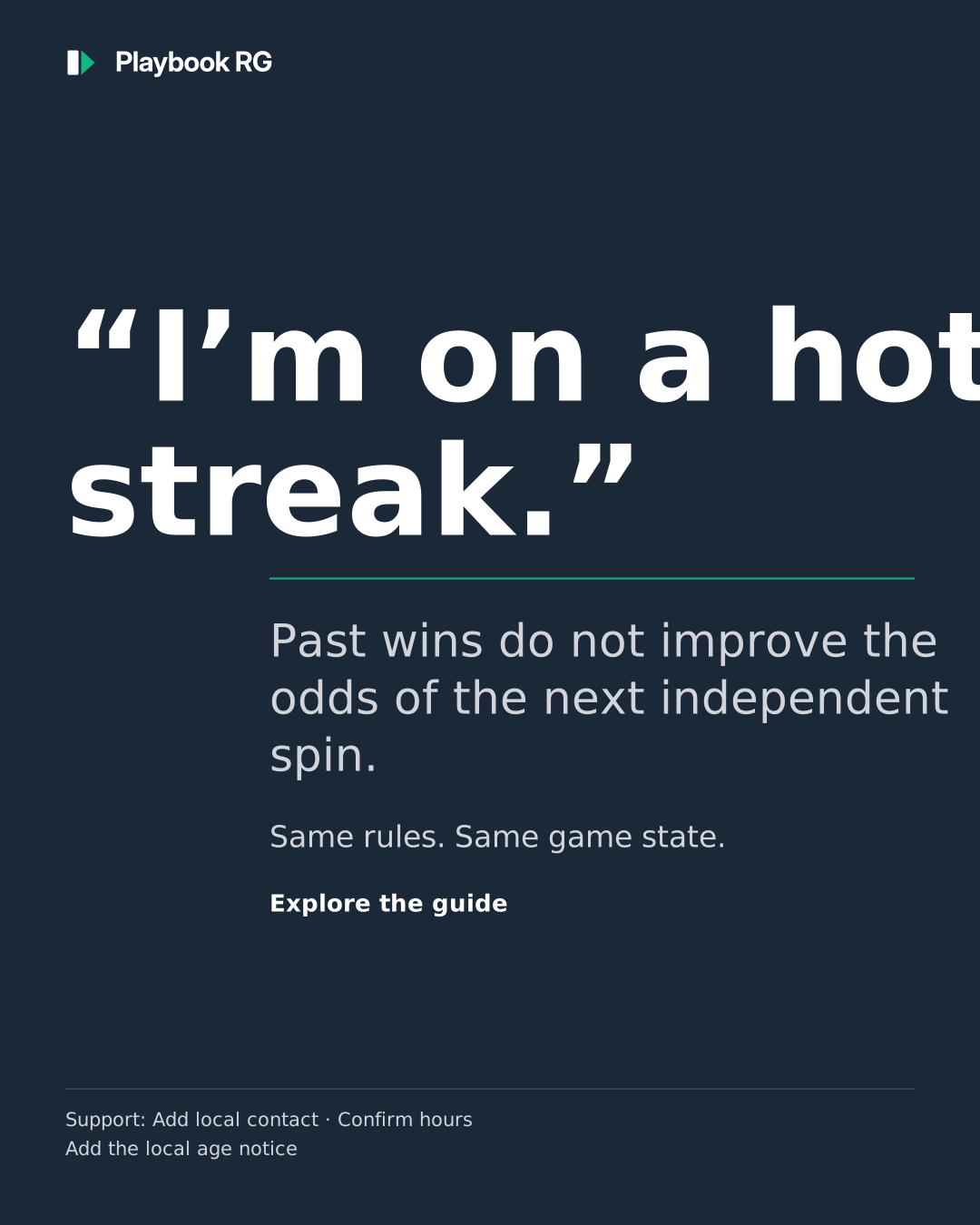
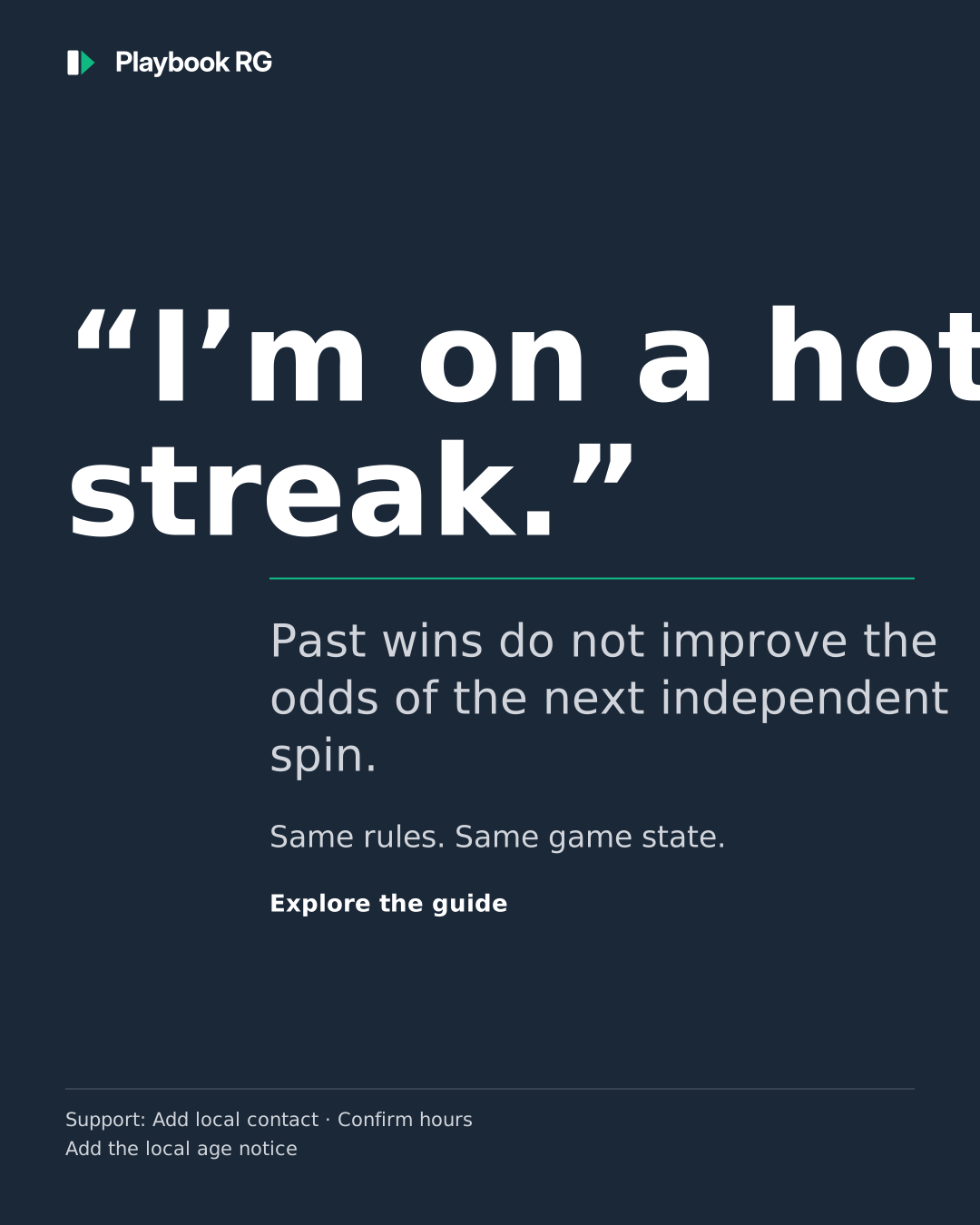
| Directness | Is the conclusion clear and supported? | “Previous independent spins do not change the next spin’s probability.” |
| Comfort | Can someone ask a question without accepting a label first? | “You can ask for support about your gambling or someone else’s.” |
A confident voice does not require certainty where none exists. Keep game conditions, relevant risk information and qualifications. A friendly tone cannot make an unsupported claim acceptable.
Narrator Script
Narrator: [transition slide] Most player education sounds like it was written by a committee of lawyers told to “make it sound helpful.” The result: material nobody reads, nobody shares, and nobody acts on.
[pause 3s] {{PROGRAM_NAME}} sounds like somebody. Specifically, it sounds like a knowledgeable friend at the table with you — someone who knows the odds, has read the fine print, understands the math behind every game, but doesn’t lecture.
[show five-traits card] Five traits define this voice. Knowledgeable — it knows the math but explains it like something interesting at a bar. Confident — it doesn’t hedge. Generous — it shares because you should have the information. At the table — the perspective comes from inside the experience. And non-judgmental — it will tell you your system doesn’t work, but never makes you feel stupid for trying it.
[show what-the-voice-is-not card] The voice is a peer in conversation, not a teacher, not a doctor, not a parent, not a killjoy. It shares; you decide. It trusts you to be an adult. Gambling is fun, eyes open.
[show five-dimensions grid] Beyond those traits, five dimensions shape how {{PROGRAM_NAME}} sounds in practice. Voice — peer, not authority. Framing — opportunity, not warning. Humor — witty, not preachy, and here’s the guardrail that matters most: humor is on for Tier 1 education and completely off for Tier 2 support and crisis. Directness — blunt, not hedging. And Comfort — open and comfortable, not stigmatizing.
[pause 3s] Each dimension has a default setting and a guardrail. Learn all five and the content writes itself.
Section 2: Stigma-Free Language
Reading
Describe the action or need rather than defining the person by a problem. These edits help make routine content specific, but they do not override required wording or replace one account tool with another.
| Draft wording | A possible revision | Check before using it |
|---|---|---|
| Problem gambler | Player / person experiencing difficulty | Do not diagnose the reader |
| Responsible gambling | Set a budget / Know the odds / Review your activity | Name the actual function |
| Gambler | Player | Respect the person’s preferred language where known |
| Gambling addiction | Difficulty with gambling | Retain accurate clinical terminology when the context requires it |
| You should self-exclude | You can choose self-exclusion | Keep the official name, duration and scope |
| Intervention | Tool / feature | Do not conceal a mandatory restriction or review process |
| Reality check | Session reminder | Retain any terminology required by local rules |
| You should | You can | Only describe an optional action as optional |
| WARNING | Heads up / a specific heading | Keep required warnings and appropriate urgency |
| The odds are against you | The house edge is [rule-qualified figure] | Explain the relevant rules and long-run meaning |
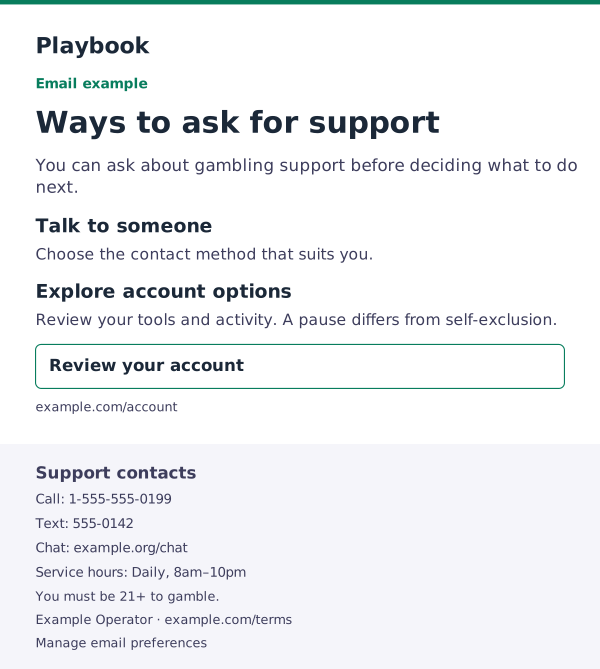
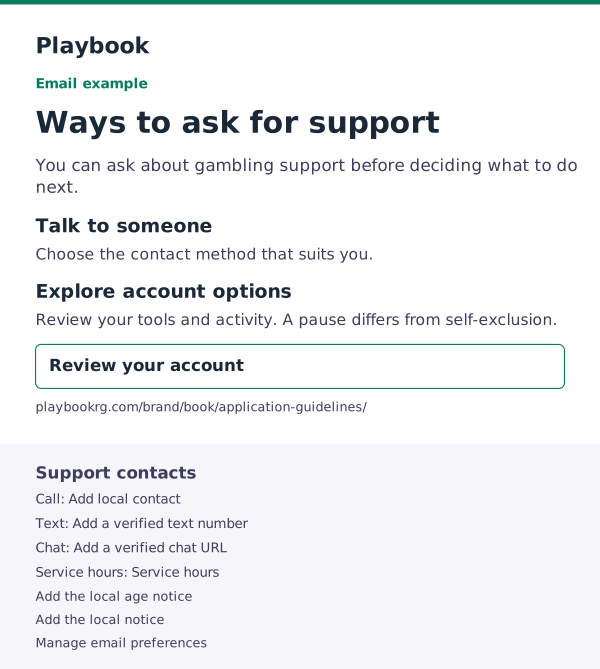
A pause is not a substitute for self-exclusion. Explain each option accurately. Do not use a friendlier name if it hides its effect, duration, coverage or conditions for returning.
A support invitation can say, “You can ask about gambling support before deciding what to do next.” Add claims such as free, confidential or available 24/7 only when the named service confirms them.
Check your internal language and compliance policies before replacing mandated terms.
Narrator Script
Narrator: [transition slide] Language shapes perception. When players run into clinical terms like “problem gambler,” “warning signs,” or “gambling addiction,” they assume the material isn’t for them. So they leave.
[pause 3s] This isn’t about being polite — it’s about being effective. The gambling industry leans on language that stigmatizes players and puts the whole burden on the individual. {{PROGRAM_NAME}} swaps that out for stigma-free alternatives.
[show top-10 swaps table] Instead of “problem gambler,” say “player.” Instead of “responsible gambling,” name the specific action — “set a budget,” “know the odds,” “check your session.” Instead of “gambling addiction,” say “difficulty with gambling.” Instead of “self-exclude,” say “take a break” or “pause your account.”
[pause 5s] These aren’t cosmetic. Research shows stigmatizing language makes people less likely to seek help. When someone reads “If you have a gambling problem, call this number,” they have to label themselves before they can pick up the phone. That’s a barrier. “Free, confidential support — for any question about gambling” removes it.
[transition to exercise] Ten essential swaps cover all Tier 1 material — social posts, app copy, emails, print, in-venue signage. Now make the swaps yourself. Below is one session reminder the compliance committee wrote the old way — a warning, a clinical label, a “you should,” all at once. Rewrite it in the {{PROGRAM_NAME}} voice. A coach scores your version against the voice dimensions and the stigma-free swaps and tells you the one thing to fix next. Revise until it lands, then continue.
Section 3: Tone Spectrum & Practice
Reading
Choose the register from the situation and the person’s stated need.
| Register | Suitable context | Example |
|---|---|---|
| Playful / Witty | A routine myth explanation or knowledge quiz | “The wheel doesn’t remember the last spin.” |
| Confident / Informative | Rules, odds or tool instructions | “Single-zero roulette has 37 pockets. Payout rules also affect the house edge.” |
| Warm / Direct | Support, distress or a sensitive account decision | “You can ask for support. See the contact options and service hours.” |
| Celebratory | A completed learning task | “You answered all five questions correctly.” |
Do not celebrate spending, extended sessions or supposed gambling success. A limit or exclusion message should state the confirmed status and what it means, without confetti or pressure to return.
The topic alone does not set the tier. A general explanation of a deposit limit can be routine education; a conversation with someone distressed about spending needs warm, direct support. Keep the same care and respect in both.
Narrator Script
Narrator: [transition slide] {{PROGRAM_NAME}} has one voice but four tone registers. Same person, different conversations. Knowing when to use each one is what separates competent brand writing from great brand writing.
[show four-registers grid] The four registers. Playful and Witty — your myth-busting, quiz, and social register. The personality shines here. Sarcasm, wordplay, confident challenges that earn attention instead of demanding it. Tier 1 only. Confident and Informative — the educational workhorse. Odds explanations, game guides, how-to material. Clear, direct, no fluff.
Warm and Direct — Tier 2 territory. Support pages, session reminders, check-in moments. This is where humor drops to zero. The voice stays generous and non-judgmental, but the tone is plain, clear, and immediate. No jokes, no cleverness, just the information the player needs. It’s one of the most important guardrails in the system: humor on for education, off for support.
And Celebratory — for quiz results, milestones, positive moments. Restrained enthusiasm. “You scored nine out of ten. Sharper than most. Challenge a friend?” Not “Amazing! You’re a champion!”
[pause 3s] Matching the register to the moment isn’t a creative call — it follows the context. Myth-busting gets Playful. Odds education gets Confident. A self-exclusion page gets Warm and Direct. Quiz results get Celebratory. The voice never changes; the register always matches the moment.
[pause 2s] Your turn to tune the dial. I’ll give you five real messages — decide which register each one calls for. Match them, then continue.
Section 4: Cultural Adaptation
Reading
Adapt wording to the audience and test it with people who know the language and context. Country labels alone are not enough to decide how direct, humorous or formal a message should be.
Keep the core commitments: accurate information, respect for the reader, clear actions, relevant qualifications and no judgment. Adapt idioms, examples, rhythm and level of directness where doing so improves understanding.
Three possible versions of the same fact:
| Approach | Example |
|---|---|
| Direct | “Previous independent spins do not change the odds of the next spin.” |
| Conversational | “That last result doesn’t make the next independent spin more likely to win.” |
| Explanatory | “When spins are independent, each uses the same probability. A sequence of losses does not make a win due.” |
Each keeps the condition that the outcomes are independent. Choose the version the intended audience understands best, then check it in the actual channel.
For translated material, verify numbers, decimal conventions, names of tools, required notices and support destinations as well as tone. Recheck layout and reading order after translation. An approved English piece is a useful reference, not approval of another language.
Narrator Script
Narrator: [transition slide] The {{PROGRAM_NAME}} voice principles are universal. The expression adapts to the market.
[show localized poster] Here’s that rule made literal. The same Know Your Game poster, here in Japanese — and the system never moves. Navy ground, teal and orange, the layout, the wordmark, the house-edge stats all hold. Only the language changes. Translate the words; never the character.
[show Brand DNA card] Five things never change, whatever the audience, language, or geography — the Brand DNA: generous with information, respectful of intelligence, honest about how things work, treats gambling as entertainment, and corrects without judgment.
[show humor and directness spectra] What adapts is how those traits get expressed, and two dimensions matter most: humor register and directness level. Humor can be bold — the irreverent sarcasm common in Australia and the US. It can be understated — dry wit for the UK. Or minimal — warm and clean for Asian and Nordic markets. All three are valid, as long as the material doesn’t read like a compliance form.
Directness follows the same idea. Take one number — American roulette’s house edge, 5.26%. Direct markets like Australia and the Nordics get it plain: that’s one of the worst bets on the floor. Diplomatic markets like the UK get the same number wrapped in comparison — higher than most table games, and it adds up over a session. Contextual markets like Japan never state the conclusion: compare the games side by side, and the difference speaks for itself.
[pause 3s] Same information, different cultural wrapping. The character holds; only the dialect changes.
Module Test
Narrator: [transition slide] Time to test what you’ve learned. Five questions covering the {{PROGRAM_NAME}} voice, stigma-free language, tone registers, and cultural adaptation. You need 80 percent to mark this module complete. Take your time and think about the principle behind each answer.
Question 1
Assesses: Learning objective 1
Stem: Which of these best describes the {{PROGRAM_NAME}} voice?
| Option | Text |
|---|---|
| A | An authority figure explaining rules players must follow |
| B | Someone who knows the game, shares the real story, and respects you enough to give it straight |
| C | A clinical expert presenting research findings to patients |
| D | A friend who avoids difficult topics to keep things light |
Correct: B
Explanation: The voice is knowledgeable but not academic, confident but not arrogant, and generous with information: a peer at the table, not a lecturer.
Source: Brand Personality
Question 2
Assesses: Learning objective 1
Stem: What’s the difference between “Witty / Not Preachy”?
| Option | Text |
|---|---|
| A | Witty content uses jokes; preachy content uses facts |
| B | Witty content earns attention through insight and humor; preachy content demands attention through moral authority |
| C | Witty content is for social media only; preachy content is for serious topics |
| D | There is no meaningful difference — both are forms of persuasion |
Correct: B
Explanation: Wit respects the reader and makes the point interesting. Preachiness talks down. {{PROGRAM_NAME}} aims humor at myths, never at players.
Source: Brand Personality
Question 3
Assesses: Learning objective 2
Stem: Which of these follows {{PROGRAM_NAME}}‘s stigma-free language guidelines?
| Option | Text |
|---|---|
| A | ”If you have a gambling problem, call our helpline” |
| B | ”You can ask for support about your gambling or someone else’s. See the contact options and service hours.” |
| C | ”Gamble responsibly — set limits to protect yourself” |
| D | ”Warning: gambling can lead to addiction” |
Correct: B
Explanation: Nobody has to accept a label to ask for support, and the actual contact options and hours replace invented service promises.
Source: Stigma-Free Language Guide
Question 4
Assesses: Learning objective 3
Stem: A player just completed the Game IQ quiz and scored 9/10. What tone register should the result screen use?
| Option | Text |
|---|---|
| A | Warm / Direct |
| B | Confident / Informative |
| C | Celebratory (restrained) |
| D | Playful / Witty |
Correct: C
Explanation: A learning result earns recognition. Keep it restrained: no ranking against other players, no predicted wins. “You scored 9/10. Review the answer you missed?”
Source: Voice and Tone
Question 5
Assesses: Learning objective 4
Stem: When adapting the {{PROGRAM_NAME}} voice for a market where direct humor feels confrontational, what changes and what stays the same?
| Option | Text |
|---|---|
| A | Everything changes — each market needs its own brand voice |
| B | The humor level stays the same but the topics change |
| C | The intent stays the same (generous, honest, non-judgmental) but the expression adapts (dry wit instead of cheeky sarcasm) |
| D | You should remove humor entirely for sensitive markets |
Correct: C
Explanation: Humor level is expression, not identity. Keep the facts and respect; adapt the wording. Test it with your audience, not a market stereotype.
Source: Brand Personality
Key Takeaways
- Write as a knowledgeable, helpful peer. Explain the facts and make the next step clear.
- Use the five voice dimensions as editing questions: voice, framing, humor, directness and comfort. Test how the complete message reads.
- Avoid labels and assumptions about the reader. Keep technical or clinical terms where accuracy requires them, and explain them clearly.
- Match the tone to the moment. Routine education can be playful; support needs calm, direct language without jokes or celebration.
- Explain the difference between a short break and self-exclusion. Do not substitute one for the other.
- Adapt wording through local review and testing. Do not infer a reader’s preference from their country or culture.
Source basis
You don’t need to read these, but they’re the published research and brand-system sources behind the module’s rules — in case a colleague asks.
- Blaszczynski, A., Ladouceur, R., & Shaffer, H.J. (2004). A science-based framework for responsible gambling: The Reno Model. Journal of Gambling Studies, 20(3), 301–313. Why it’s here: the informed-choice foundation behind the peer-not-authority voice and the “shares; you decide” framing — players as autonomous adults, not patients.
- Miller, H.E. & Thomas, S.L. (2017). The problem with ‘responsible gambling’: impact of government and industry discourses on feelings of felt and enacted stigma. International Gambling Studies, 17(2), 290–307. Why it’s here: the evidence that clinical, “responsible gambling” framing produces stigma — the case for the 10 swaps and the phrases-to-retire list in Section 2.
- Hing, N., Russell, A.M.T., & Gainsbury, S.M. (2016). Unpacking the public stigma of problem gambling: the process of stigma creation and predictors of social distancing. Journal of Behavioral Addictions, 5(3), 448–456. Why it’s here: documents how labels like “problem gambler” drive avoidance rather than help-seeking — why person-first language keeps the door open.
References
| Resource | What to use it for |
|---|---|
| Brand Personality | The voice, the five traits, “at the table” framing, the five dimensions |
| Voice and Tone | Voice principles, the four tone registers, sample rewrites |
| Stigma-Free Language Guide | The full term-swap list, context-dependent terms, testing checklist |
| Cultural Adaptation Guide | Brand DNA vs Brand Expression, humor and directness spectrums by market |
Interactive exercise
Tone Matcher
What tone register is this?